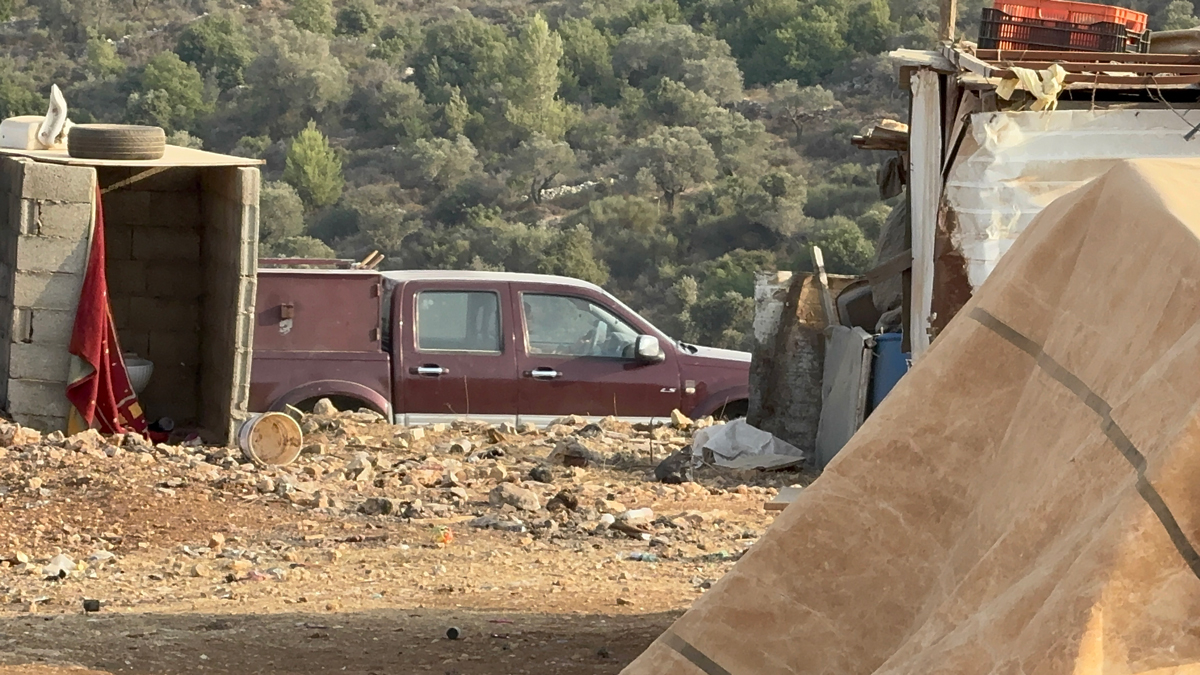
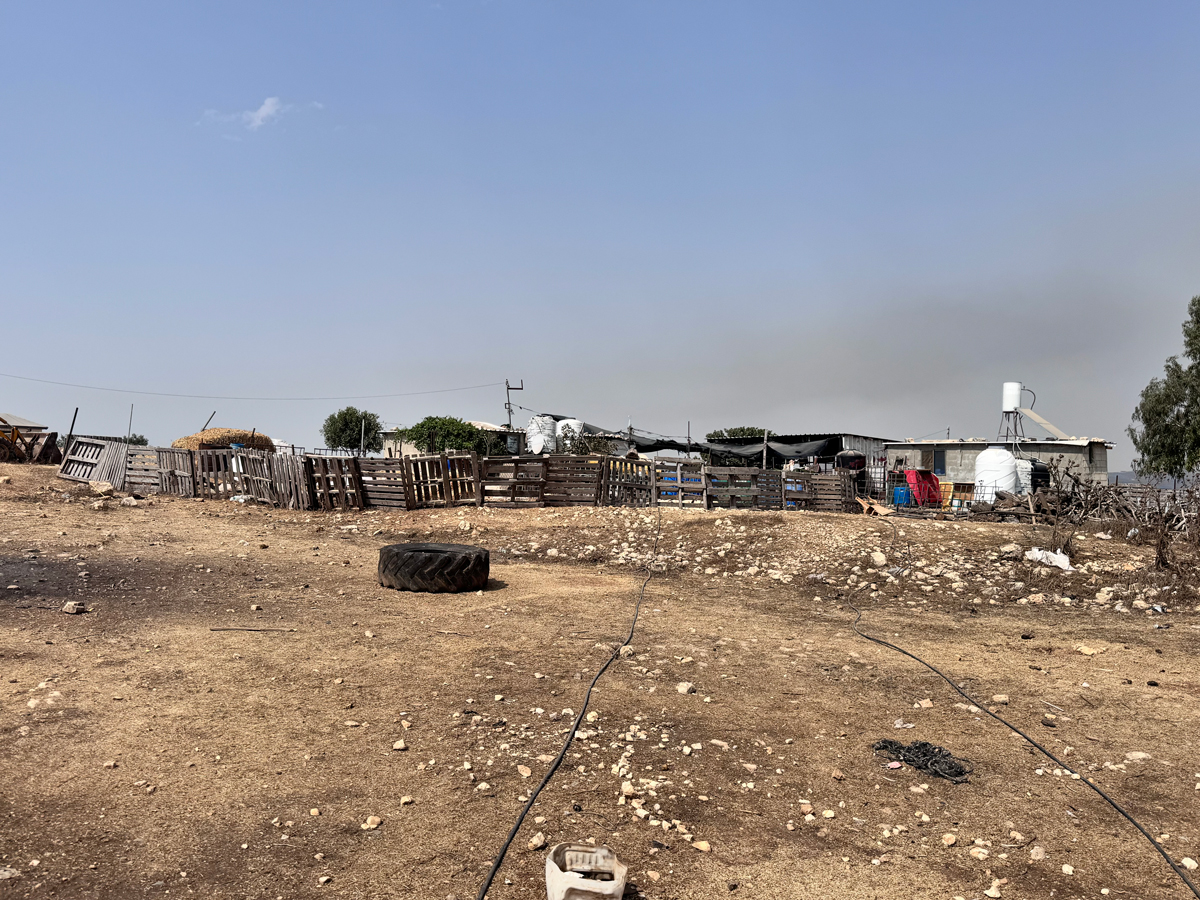
A settlers’ vehicle near the community’s residential compound. Photo courtesy of local residents
Dar Sh’alan, a community of seven families with a total number of about 50 people, including 30 children, was located about 50 meters from the village of ‘Atarah in the Ramallah District. The community had lived at this site, which lies in Area B under the Oslo Accords, for some 50 years, subsisting on farming and shepherding and living in tents and shacks.
On Monday, 4 August 2025, at around 9:30 A.M., three settlers arrived by car at the community’s residential area, armed with a rifle, a handgun and an axe. The settlers began walking among the tents and shacks and threatened to harm the residents if they did not leave the area within five days.
On Sunday afternoon, 10 August 2025, community residents noticed that settlers had begun fixing the dirt road that runs about 20 meters from residents’ homes, using a bulldozer.
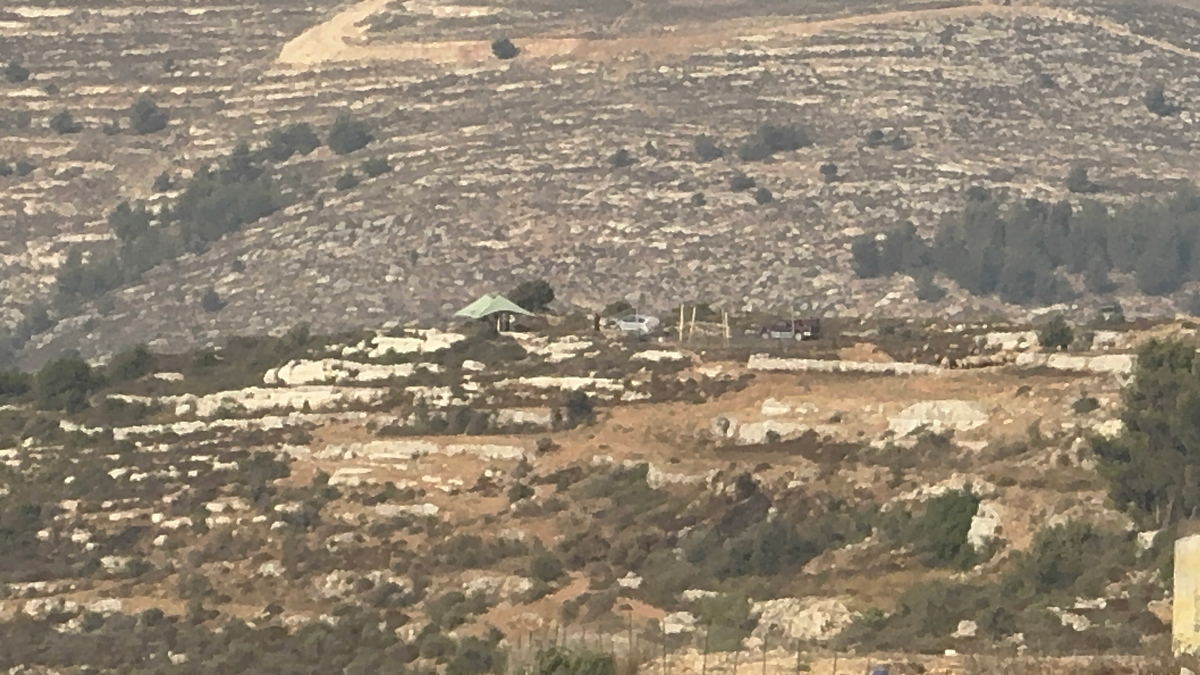
The next day, before dawn, the residents heard noise coming from a nearby hill, in an area known as Khirbet Tarafin, about 500 meters east of the community, also in Area B and up the road the settlers began fixing the previous day. When the sun rose, the residents realized that the settlers had set up a new outpost on that hill and had brought a flock of sheep there.
Since the outpost was established, the settlers have regularly used the road that runs near the community’s homes and harassed its residents.
Homes in the community of Dar Sh’alan before the expulsion. Photo: Mohammad Romaneh, B’Tselem
On 23 August 2025, a settler rode a donkey along this road to the community’s homes and threatened one of the women. He then spat at other residents and left.
That day, the residents decided to leave the area and moved their sheep to the village of ‘Atarah.
Over the course of two days, the residents moved their belongings to the village, but left the tents in place. Some of them continue to visit the area regularly.
B’Tselem field researcher Mohammad Romaneh collected the testimony of Samir Sh’alan, 53, a father of eight, on 11 August 2025, just days before the residents were forced to leave their homes
All my children are married, and two of them live with me in the community. We live in tents made of tarpaulins and metal frames, in an area located south of the main entrance to the village of ‘Atarah. I was born here more than 50 years ago and have lived here all my life.
My grandchildren attend school in the town of Bir Zeit and get there by public transportation. We have about 1,000 head of sheep in the compound.
The ‘Atarah Checkpoint is about 700 meters away from us. This area is considered Area B under the Oslo Accords, and I lease the land on a yearly basis from the owner, who lives in the United States. About 100-150 meters southeast of our compound, there’s a landfill.
For many years, we grazed our sheep in the area of Khirbet Tarafin, east of the compound, and I also farmed land there with the owner’s consent and grew wheat, barley, peas, pumpkin and zucchini, because the soil there is very fertile. I also harvested olives there with his consent, and my yield came to 250 containers of olive oil a year.
On Monday, 4 August 2025, at around 9:30 A.M., when I was in our residential compound, I saw a white pickup truck driving on the road south of the compound, about 20 meters from the tents, toward Khirbet Tarafin. There were three people in the vehicle, all with beards and skullcaps, and I understood that they were settlers. I saw that one of them was armed with a long rifle. At that time, four family members, my brothers and my sons, were grazing sheep in Khirbet Tarafin, so I got into a neighbor’s car right away and drove there quickly.
Because I know the area well, I reached my brothers and sons before the settlers did, but as soon as I stopped next to them, the settlers’ vehicle also arrived, and a young man of about 25 got out, holding an axe.
He asked me in fluent Arabic, “Are you the Bedouin who lives near the main road?” When I replied that I was not Bedouin but a farmer who was born in ‘Atarah, he said, “You have to leave here quickly”. I asked, “Why do I have to leave when I’ve lived here for more than 50 years?” and he replied, “You’re blocking our way, leave”. Then he got back into the vehicle, and they drove toward our tents.
The Kfar Tarfon outpost that settlers set up in Khirbet Tarafin. Photo: Mohammad Romaneh, B’Tselem
I was very afraid they would attack the women and children who were in the tents, so I went back there quickly. When I arrived, I saw their pickup truck next to the tents. All three settlers had already got out. One was armed with a rifle, the second had a handgun in his belt, and the third was the young man with the axe. They walked around among the tents, and my brother told me that before I arrived, they told him that we had five days to leave. Then they got into the vehicle and drove away.
The road the settler complained I was blocking is a dirt road that runs 20 meters south of our tents and is used mainly by the ‘Atarah local council’s garbage trucks. The council opens and closes it as needed, and I have nothing to do with that. The road the settlers use to get to Route 465 is also an important route for residents of ‘Atarah and the surrounding area sometimes, when the checkpoint is closed.
On Sunday afternoon, 10 August 2025, settlers came with a bulldozer and fixed the road south of our compound as far as Khirbet Tarafin, as well as the road between the village’s main road and Route 465.
On Monday, 11 August 2025, shortly before dawn prayer, I heard noise south of the community and saw an unidentified vehicle towing a trailer with equipment, driving east toward Khirbet Tarafin. After about 10 minutes, we heard voices coming from the east. When the sun rose, we saw that the settlers had put up two tents 500 to 600 meters east of our tents, in Khirbet Tarafin, and brought a flock of sheep with them, which means they had set up a shepherding outpost there.
Since then, their vehicles have been driving by our tents every day, and they’ve been stopping here, mocking us and trying to provoke us.
My greatest fear is that the settlers will attack us, or that they will steal our sheep or harm them. The establishment of the outpost in Khirbet Tarafin is a real threat that prevents us from accessing the farmland, which is our main source of livelihood.
We depend on this land for our livelihood, for grain, olive oil and pasture, and we can’t graze south of the community because of the military checkpoint. Khirbet Tarafin was the only area where we could graze. Since the settlers threatened us, we haven’t been taking the sheep out of the yards at all, and I’ve sprayed them with red paint to mark them in case the settlers try to steal them.
Israel’s regime of apartheid and occupation is inextricably bound up in human rights violations. B’Tselem strives to end this regime, as that is the only way forward to a future in which human rights, democracy, liberty and equality are ensured to all people, both Palestinian and Israeli, living between the Jordan River and the Mediterranean Sea.
Since the Hamas attack on 7 October 2023, Israel has acted in a coordinated and deliberate manner to destroy Palestinian society in the Gaza Strip, committing genocide against its residents. In light of Israel’s actions in Gaza, the public statements made by Israeli decision-makers, and the international community’s failure to take effective action, there is a serious risk that the Israeli regime will expand the genocide to other areas under its control—first and foremost, the West Bank.
B’Tselem calls on the Israeli public and the international community to use every tool available under international law to bring an immediate end to Israel’s genocide against the Palestinian people.