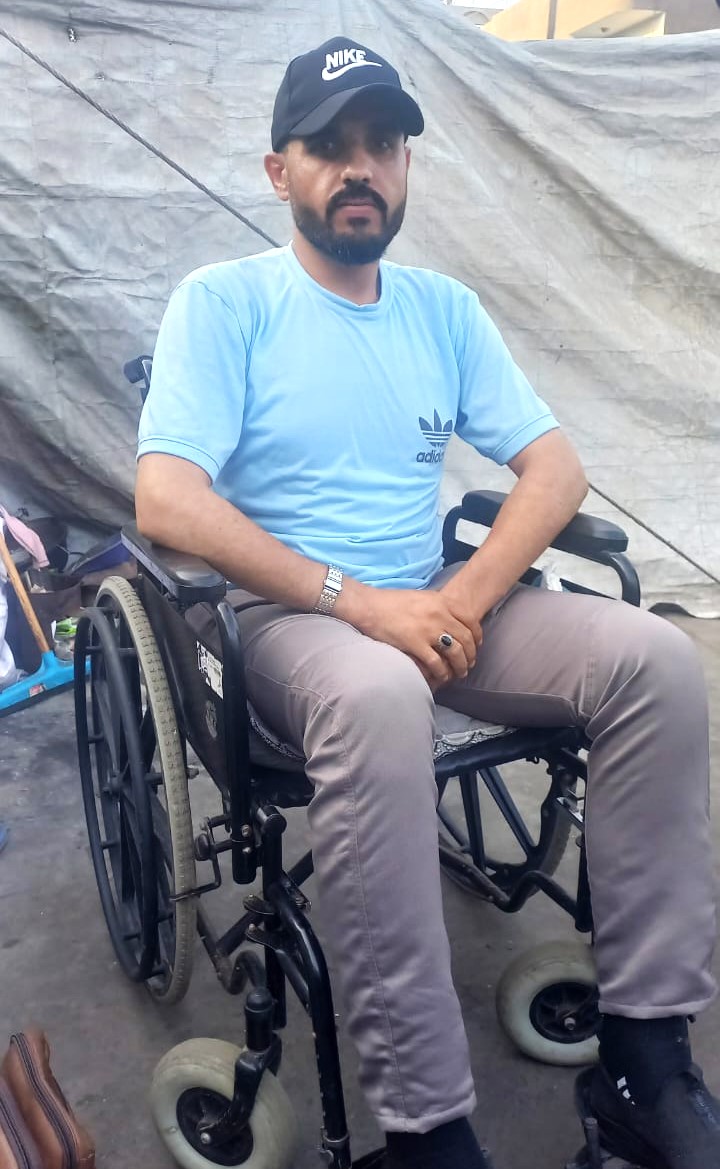
Until the war, I lived with my wife, Faeqah Khader, 37, a nurse, and our five children: Rimas, 16, Manar, 14, Hassan, 11, Layan, 9, and Mustafa, 5, in Beit Hanoun. I have asthma and take medication regularly. When we first got married, we lived in a rented apartment and moved several times. Then, in 2020, I borrowed money from friends and relatives and built us a 120-square-meter house. I’ve paid off USD 5,000 of the debt for building the house, and I still owe USD 11,000.
I worked as a taxi driver, both before and after I got married, because in the bad economic situation in Gaza, there were no real work opportunities that would allow us to live a decent life. Because Beit Hanoun is close to the Israeli border, the area was very unsafe even before the current war, and there were many shooting incidents and attacks by the Israeli military. That’s why during previous wars and military operations in the Gaza Strip, we always left Beit Hanoun.
In the past two years since the war began, my family and I have been through a lot of hardship: displacement, hunger and more. I was arrested and abused, physically attacked and sexually assaulted – experiences that affected me and will continue to affect me for the rest of my life.
On 7 October 2023, my wife was getting the children ready for school, and our youngest son, Mustafa, for kindergarten, when rocket fire started and we realized an Israeli attack on Gaza was coming. I was very afraid for my wife and children, so I sent them to my father-in-law’s house in a-Sheikh Radwan neighborhood in western Gaza City. My mother and I stayed home. The next day, from the early morning hours, the military called out orders over loudspeakers to evacuate the area. At , the same time, they began attacking high-rise buildings with missiles and artillery so massively, it’s hard to imagine. We couldn’t stay there for another second. I left the house with my elderly mother, and we walked to al-Fakhura clinic in Jabalya Refugee Camp. My wife and the children joined us there, and we all stayed together in the clinic’s medicine room.
I felt them peeing on us. While they were doing that, they swore at us: “Sons of bitches! Sons of whores!” One soldier said to me: “I’m going to rape your sister [...]”
The clinic was overrun with IDPs. There were more than 3,000 people there who had fled Beit Hanoun and a-Sheikh Zaid. But there was no doctor there, and my wife, who is a nurse, tried to treat the sick. The whole time we were there, we suffered from the hunger that spread across the northern Gaza Strip, because the Israeli military denied us food and water. I risked my life and went to dangerous areas to find food for my family.
In the winter of 2024, the killing and the hunger in northern Gaza reached new heights and I couldn’t even find a crumb of bread for my family. People in the north were killing each other for food. My wife refused to stay there because of the severe hunger, so on 13 March 2024, I drove her, our children and my mother to a-Rashid Street, which was the only way to go south. I was afraid that if I passed through a checkpoint, I’d get arrested, which I’d heard had happened to many other men, so I went back to the clinic.
At first, my family went to Rafah. Then they moved to Khan Yunis, and from there to Deir al-Balah. The whole time they didn’t have enough food and money. I sold scraps and sent them money so they could buy food to survive.
I stayed at the clinic until the military invaded Jabalya in October 2024, and things there became very dangerous. From there, I went to a-Saftawi clinic west of the camp. On 25 October 2024, the Israeli military surrounded the clinic, after we refused to leave it because we had nowhere to go. The clinic was surrounded by tanks and drones. We were afraid to go outside. The military sent over a young man they used as a human shield. They forced him to walk in front of the soldiers while a drone flew above him, and he was exposed to their fire. The young man reached us and told us that we had to leave the clinic within an hour and go west.
We were forced to leave. At 9:00 A.M., we all left the clinic and walked until we reached a military checkpoint near the Jabalya Sports Club. At the checkpoint, one of the soldiers called me over along with some other guys. He ordered us to stand by the tank, right in front of a camera they’d set up there. The soldiers came over to us, tied our hands with zip ties and beat us hard with their guns, including in our faces. The blows made my mouth bleed.
When one of the detainees asked for water, a soldier peed into a bottle, shoved it into his mouth and said: “Drink, you son of a bitch.”
They lined us up in a row, together with dozens of other detainees, packed together like sheep. We were handcuffed and blindfolded, and they forced us to get down on our knees with our heads between our legs. I managed to see under the blindfold that the soldiers climbed up to a high spot, and I felt them peeing on us. While they were doing that, they swore at us: “Sons of bitches! Sons of whores!” One soldier said to me: “I’m going to rape your sister, son of a whore, and I’m going to rape your wife!”
They kept us in that position until dawn the next day, and then they put us in large trucks. They threw inside like sacks of flour, beating us hard. The truck drove for about an hour until we reached some place, apparently inside Israel. There, they threw us out of the truck onto a surface covered with gravel and stones, which cut my arms and legs. They peed on us there, too. Also, when one of the detainees asked for water, a soldier peed into a bottle, shoved it into his mouth and said: “Drink, you son of a bitch.”
After that, they replaced the zip ties on our hands and feet with metal cuffs and put us in a prison. From what the other prisoners said, I understood we were at Sde Teiman. There were large shacks there, with a lot of cells in each one that looked like cages. They gave us new clothes and put a wristband on me with the number 059517.
When I entered the prison, my face and eyes were swollen from all the beating. A doctor in uniform came to examine us and I told him that I have asthma, that I suffer from pain and breathing problems and that I regularly use Ventolin, but he ignored me.
The next day, a soldier called out my number and took me to a jeep that drove me to another place, which I later learned was called al-Hasmah (a gravel-covered compound). It was a place where detainees were interrogated and tortured. They sat me on an iron chair, stripped me and gave me a physical search. I stayed tied to the chair for three hours straight, blindfolded with three layers of cloth, and my feet in shackles. The officer who interrogated me introduced himself as “Captain Abu Ramez” and said he was in charge of the Beit Hanoun area.
He asked which organization I belonged to, and I told him I didn’t belong to any organization and that I was just a civilian who worked as a taxi driver. During the interrogation, he beat me hard in the face and back and threatened to kill my wife and children.
After the interrogation was over, they took me back to the Sde Teiman prison. The conditions there were extremely harsh and degrading, in ways that cannot be described. They beat us severely, tied us in the “shabah” position [a stress position] and oppressed, humiliated and cursed us. I was blindfolded and handcuffed for almost my entire time in detention.
There were 60 prisoners in each cage and only 24 beds. We slept huddled together in the beds. They didn’t let us shower or shave. They brought us three meals a day, each consisting of a very small piece of bread and a bit of tuna. They would say to us: “Here, you eat only to stay alive.”
They brought us three meals a day, each consisting of a very small piece of bread and a bit of tuna. They would say to us: “Here, you eat only to stay alive.”
For most of my time in detention, I didn’t know what time, day or date it was. During one of the raids, the soldiers broke into the cells, threw [tear] gas canisters and beat us severely. I think they broke some of my ribs. Later, I learned that two detainees, ‘Adel al-Kahlut and Mu’az Rayan, had died. During the same raid, they tortured me and injected something into my leg twice. I don’t know what it was. Afterwards, the soldiers hit me on the back of the head with a stick. I fell down and passed out. I woke up outside my cell and heard to the sounds of beating, degradation and swearing from the guards. They threw me back into the cell. I think it was in late November 2024. From that point on, I took a turn for the worse. I lost the ability to move. I couldn’t get out of bed. Other prisoners helped me move around, and there was also a doctor there who treated me.
I stayed in that condition until early December 2024. Then, guards came and took me for interrogation. On the way there, they beat and tortured me cruelly the whole time, and hurled abuse at me such as, “We’ll fuck your sister, we’ll fuck your wife, you son of a bitch!”
They sat me in a wheelchair and took me to a place called “the disco,” which had several rooms. They played loud music there, blasphemous statements against Allah and curses. I’m still have hearing loss in one ear.
I stayed under interrogation in “the disco” for three days straight. I had a remote court hearing over Zoom. My detention was extended until further notice under the classification of “unlawful combatant.”
One of the times they took me for interrogation, the officer interrogating me asked who had injured me. I answered: “You gave me an injection and hit me on the head.” In response, he started beating me savagely in the face and head. Then he asked where I lived, what I did for a living and where I’d been at the beginning of the war.
Then he asked where my wife and my family had fled. I told him I didn’t know, so he beat me again. He used pliers to pull the nail out of my right index finger, and I started screaming and crying loudly from the pain. He slapped me, tried to choke me, tied my hands behind my back, pulled me and hit me hard in the chest. I started shouting: “I have a slipped disc! I have a slipped disc!”
My hands were cuffed. The soldiers grabbed me, lifted me up by my arms and hung me in the “shabah” position, with chains, in the middle of the interrogation room.
He left me there, bleeding from my face and finger. They left me there, tied to the chair, for about 10 hours. Then they released me from the chair. A doctor came to examine me, and I told him I was sick and couldn’t move, but he ignored me and didn’t even give me a painkiller. They carried me back from there to the “disco” area, still handcuffed.
Two days later, the soldiers took me for interrogation again. I couldn’t walk or move my left hand. I don’t know what they did to me to put me in that state, of being unable to move my hand.
In the interrogation, the officer asked again, “Where are your wife and children?” I told him I didn’t know where they were, even though I knew they were displaced in the southern Gaza Strip. At that moment, he ripped out the nail out of my left middle finger, and I started screaming and crying. The officer said, “We found your wife and children. They’re displaced in al-Masha’lah in Deir al-Balah. I promise you, I will make you mourn them and your whole family.” I answered him, “They are no better than those who have already died, may God have mercy on them.” That was one of the most agonizing moments of torture I went through. He called the soldiers. My hands were cuffed. The soldiers grabbed me, lifted me up by my arms and hung me in the “shabah” position, with chains, in the middle of the interrogation room.
They brought a dildo and put it under my buttocks, and then began lowering the chain while holding me, until part of the dildo entered my anus. It was the worst pain I’d ever experienced.
They brought a dildo and put it under my buttocks, and then began lowering the chain while holding me, until part of the dildo entered my anus. It was the worst pain I’d ever experienced. I started screaming and sobbing. That was the cruelest, harshest torture I went through during my entire detention in Israel. I wasn’t expecting them to sexually assault me. When it happened, I wanted to die. Death would have been better than such torture. I started screaming: “I swear to God, if I had anything to say, I would say it! I swear to God!” Then the officer ordered the soldiers to take me down. He brought me tea and water, but I refused to drink. He said: “We’ll take you back to Sde Teiman, dog.”
They took me back to Sde Teiman. From the moment I got there, I started experiencing symptoms that I later understood were signs of a stroke. But there was no one there to help me, and I didn’t get any medication or treatment. The only people who helped me were the other detainees in my cell, who took me to the bathroom, washed me and cleaned me.
In early February 2025, I started suffering from constant nausea, weakness, shortness of breath and a heavy feeling in my chest. I was taken from Sde Teiman to a hospital by ambulance. I didn’t know where they were taking me, but I guessed it was Soroka Hospital. When I got there, I was put on a bed in a room. A doctor came and injected something into the lower part of my spine. Immediately, my legs and my left arm became completely paralyzed. I screamed very loudly every time he pricked me, and the soldier next to me kept hitting me in the face until blood ran from my face and mouth.
A doctor came and injected something into the lower part of my spine. Immediately, my legs and my left arm became completely paralyzed.
After that, they took me back to Sde Teiman and held me in Ward 2, Room 3. I was surprised to find my brother Khader in that room. He was a prisoner there. At first, we didn’t recognize each other, because our faces and bodies were so disfigured from the torture and severe beatings. My brother and I hugged and burst into tears. He started crying when he saw my condition and realized I couldn’t move or walk at all.
Two days after I was returned to Sde Teiman, I started feeling groggy. At some point I totally passed out, and when I woke up, I don’t know how long afterwards, I found myself in the Sde Teiman hospital with my hands and feet tied. I was in diapers, and my mouth was twisted on the right side. I felt helpless and couldn’t speak. My vision was blurry, all because of the torture and beatings I had taken to the head. I stayed in the hospital for a total of five days, during which I was beaten and abused, shackled to the bed.
During my hospitalization, doctors gave me fluids through an IV. I asked one of them for some water to drink. Someone brought a bottle and said to me, “Open your mouth.” When I drank, it was urine, not water. He forced me to drink all of it and poured the rest on my face. I started crying, shackled and unable to move or speak.
On my second day in the hospital – I don’t know the exact date – I was transferred by ambulance to Ramla Prison, where there is a medical clinic. The doctors examined me and told me they would transfer me to a Shin Bet interrogation. They washed me and changed my urine bag, and then sat me in a wheelchair before taking me to the interrogation room. I still couldn’t speak at that point. I heard one doctor in a soldier’s uniform say to another: “Why’s this idiot not talking?” The other doctor answered: “He had a stroke.” That’s how I found out I’d had a stroke.
From the clinic, I was transferred to a ward in Ramla Prison, where several detainees from Gaza took care of me. I was given 27 pills every day. The detainees would wash me, take me to the toilet and clean me. I started taking 4,000 mg of Keppra and baby aspirin. A month later, I gradually started speaking again.
I stayed in Ramla Prison until 27 May 2025, and then I was transferred to Ofer Prison, where I received some medication, but only a very little bit.
On 10 October 2025, we found out the war was over. They transferred us to Negev Prison (Ketziot) and told us that we were going to be released. A Red Cross representative came and asked us to fill out a questionnaire with our personal details. Three days later, on 13 October 2025, they put us on buses that drove us to Karam Abu Salem (Kerem Shalom) Crossing. I was in a wheelchair. We crossed into the Gaza Strip and then we were taken by bus to Nasser Hospital in Khan Yunis. They told us that our families would meet us there. When I met my family, I saw the shock on their faces. They thought I’d died in prison. They were also shocked that I was in a wheelchair and couldn’t move my left hand. I’m still in the same condition.
I was released, but my brother Khader is still in prison.
I spent 12 months in the occupation’s prisons. I went in healthy and whole, and came out severely hurt, physically and mentally, from the torture I endured. I’m still displaced in Deir al-Balah, living in a school building near the sea and using a wheelchair. I’m in a terrible state, psychologically and physically, from the torture and beatings I suffered and from the sexual assault. I’m in pain and have insomnia, restlessness and constant thoughts about what happened to me, especially the rape.
* Testimony given to B’Tselem field researcher Muhammad Sabah on 12 November 2025
