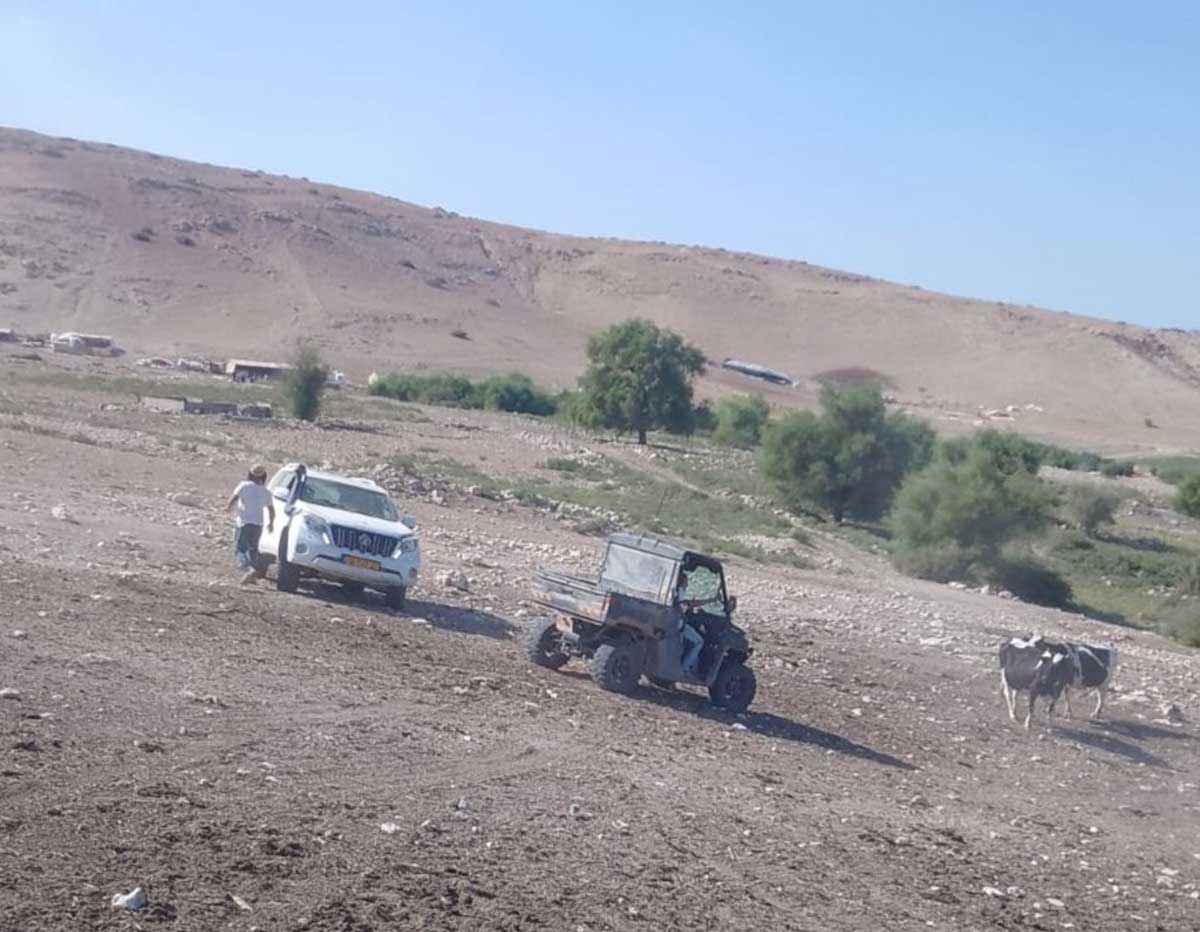
Settlers arrive at the al-Himma community. Photo courtesy of local residents
On Saturday, 27 September 2025, at around 3:00 P.M., four settlers arrived in a white Toyota and an ATV at the northern section of the community of Khirbet Tall al-Himma, which lies about one kilometer west of the town of ‘Ein al-Beida and about half a kilometer south of the village of Bardalah. The settlers wandered among the homes for some time, threatened the residents, and told them they were not allowed to continue living there and must leave the area.
Hassan Abu Zahu, 47, spoke about the settler invasion and threats in a testimony he gave B’Tselem field researcher ‘Aref Daraghmeh on 30 September 2025:
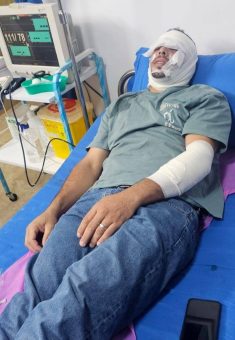
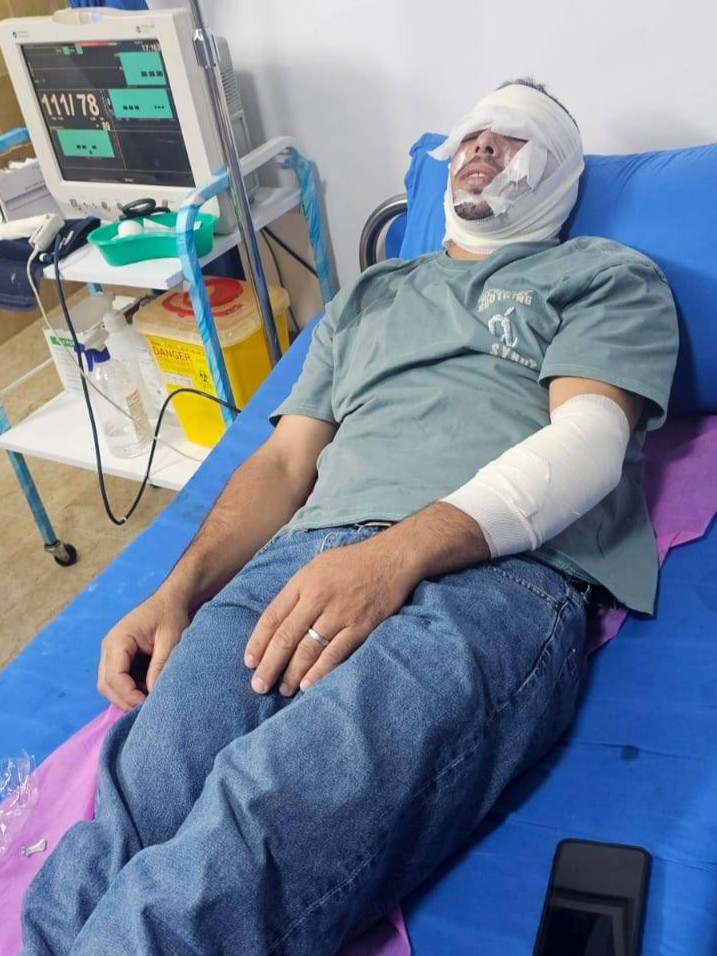
Muhib at the clinic. Photo courtesy of local residents
I have lived in Kh. Tall al-Himma for decades. My brothers live around me, and like all the residents of the community, we make our living raising sheep and cattle, and struggle with extremely harsh conditions in order to keep living here and provide for our families.
On Saturday, 27 September 2025, at around 2:30–3:00 P.M., while we were preparing the flock for the afternoon milking, a white jeep and an ATV suddenly showed up with at least four settlers, who got out of their vehicles and started threatening us and shouting that we had to leave. They stayed for some time in this part of the community, walking among the tents and homes, scaring the children and the women and everyone around, and kept shouting: “Leave this place. You are not allowed to stay here!”
In the past, I could take the flock out to pasture and reach areas located kilometers away from the community, to the west and north, all the way to Khirbet Jabaris and Bardalah, and even farther. Today, I can barely go farther than the tent. I sold part of the flock so I could afford to feed the rest. We don’t know what to do. Many shepherding families have already been driven out of the Jordan Valley due to settler threats and shrinking grazing areas. There is daily harassment here, and we fear for our lives. Settlers come on ATVs and in vehicles, drive around in front of the tents, and command us menacingly: “Leave.” People here take their threats seriously, because we have heard and seen how they attack others. We’re afraid they’ll come back and drive us out.
The settlers then went to a more southern part of the community, near al-Himma spring, where Rafe’a Fuqahaa, 69, was sitting near his herd of cattle, about 100 meters from his home. When he saw the settlers approaching, he stood up. The settlers got out of their vehicles, and one of them assaulted Fuqahaa and snatched money from his shirt pocket. Fuqahaa grabbed the settler’s hand and managed to take back his money, at which point the other settlers joined the assault and knocked him to the ground.
Fuqahaa’s son, Muhib, 35, who was near the house, saw the settlers assaulting his father and knocking him down. He picked up a stone and shouted at the settlers to leave his father alone. Muhib went over to his father. The settlers pushed him, and one of them pepper-sprayed him and his father in the face. Muhib fell to the ground next to his father.
Soon, more family members and community residents arrived to help Rafe’a and Muhib, and the settlers left. The residents took Muhib to the clinic in the village of Bardalah, where staff treated his eyes and his arm, which had been injured from the fall, and gave him painkillers. His father refused to go to the clinic.
The family brought Muhib back home when the military and the police arrived at the scene more than an hour after the assault. The officers took Rafe’a and Muhib Fuqahaa’s statements about the assault and told them they would be called into the police station to file a complaint. The officers also told Muhib that the settlers claimed he had assaulted them and threatened them with a stone.
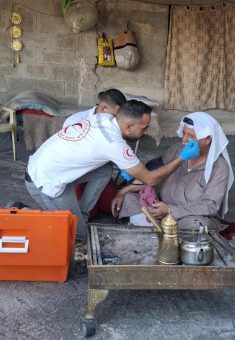
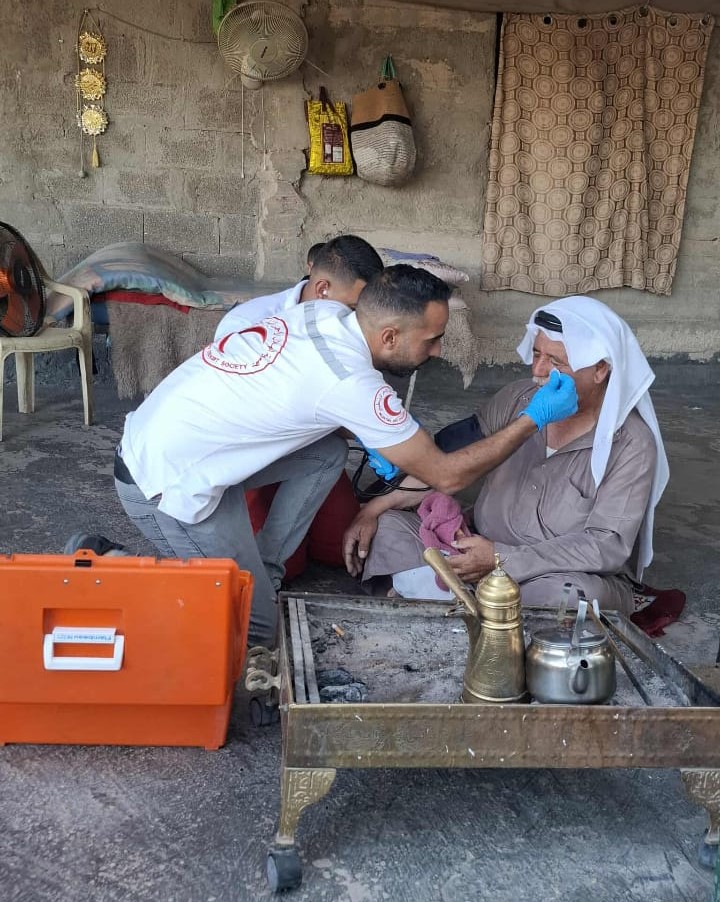
Later, a Red Crescent ambulance from Tubas arrived, and the paramedics provided further treatment to the father and son for the pepper spray and the injuries they sustained when they were knocked to the ground.
Rafe’a Fuqahaa, 69, described how settlers tried to steal from him, knocked him to the ground and assaulted him and his son with pepper spray in a testimony he gave B’Tselem field researcher ‘Aref Daraghmeh on 29 September 2025:
Rafe’a receiving treatment. Photo courtesy of local residents
On Saturday, 27 September 2025, at around 3:00 P.M., while I was sitting on the ground near my cows, four settlers suddenly approached me. I had a few bills in my hand, and I put them in my shirt pocket as I stood up. One settler came up to me and managed to snatch the money from my pocket even though I tried to stop him. I grabbed his hand and managed to take the money back, and then they all pounced on me and knocked me to the ground. I tried to defend myself, but they were young and outnumbered me, and I couldn’t fight them off.
My son Muhib, who was there, came over and told them to leave me alone. They pepper-sprayed both of us. I stayed lying on the ground until people from the village and my family members came, and then the settlers took off. The pepper spray burned, and the residents and villagers tried to treat me and Muhib. They took him to the clinic in the center of Bardalah, and I preferred to stay home. They put ointment on my eyes and face. After a long while, a Palestinian Red Crescent ambulance arrived from Tubas.
More than an hour after the incident, the Israeli police and military showed up. We spoke with them about what happened and about how we were assaulted. The Israeli police claimed that the settlers had also been assaulted and that my son Muhib had held a stone in his hand. They wanted to arrest him. We told them he had been taken to the Bardalah clinic for treatment. Family members brought him home from the clinic with bandages over his eyes and arm because of the pepper spray and the injuries he sustained when he fell. The officers took our statements and said we would be called in to file a complaint at the station. They said the settlers had filed a complaint against Muhib.
I have lived in the Tall al-Himma area for decades and make my living raising sheep and cattle. These are the hardest times I have ever experienced in my life. The settlers harass us on a daily basis, raid our community with vehicles and ATVs, prevent us from grazing, and try in every possible way to drive us out of our home and take over the spring and Khirbet al-Himma.
We don’t know what to do or where to go. No one listens to our complaints. It’s difficult and dangerous for us here. The settlers have turned us into prisoners in our own homes. We’ve never experienced attacks like the ones we are going through now. The occupation has been after us for years; the military breaks into our homes and trains on our land, but what the settlers are doing to us now has never happened before. I fear for my sons’ safety and for my own safety and livelihood. The settlers will not leave us alone. They have no mercy, and all the institutions of the occupation back them up no matter what they do.
Israel’s regime of apartheid and occupation is inextricably bound up in human rights violations. B’Tselem strives to end this regime, as that is the only way forward to a future in which human rights, democracy, liberty and equality are ensured to all people, both Palestinian and Israeli, living between the Jordan River and the Mediterranean Sea.
Since the Hamas attack on 7 October 2023, Israel has acted in a coordinated and deliberate manner to destroy Palestinian society in the Gaza Strip, committing genocide against its residents. In light of Israel’s actions in Gaza, the public statements made by Israeli decision-makers, and the international community’s failure to take effective action, there is a serious risk that the Israeli regime will expand the genocide to other areas under its control—first and foremost, the West Bank.
B’Tselem calls on the Israeli public and the international community to use every tool available under international law to bring an immediate end to Israel’s genocide against the Palestinian people.