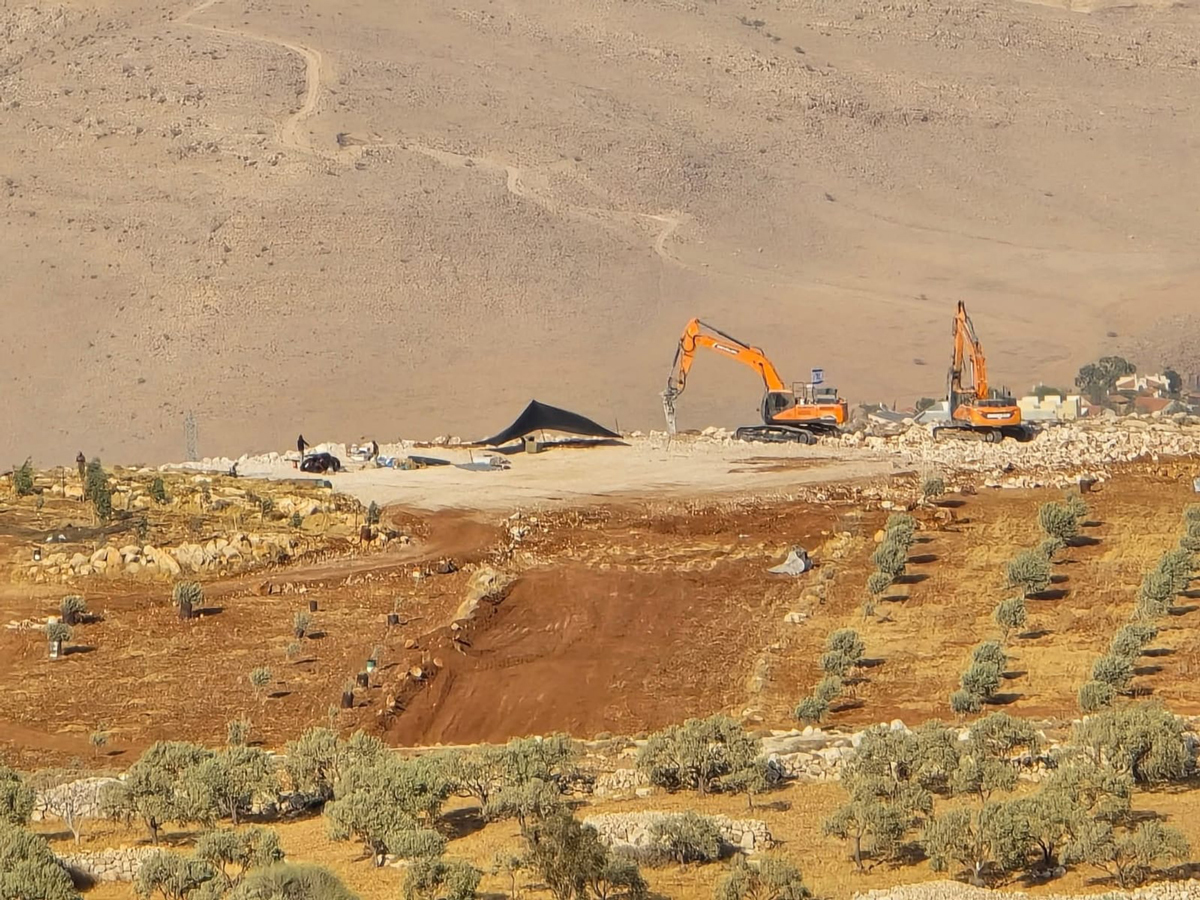
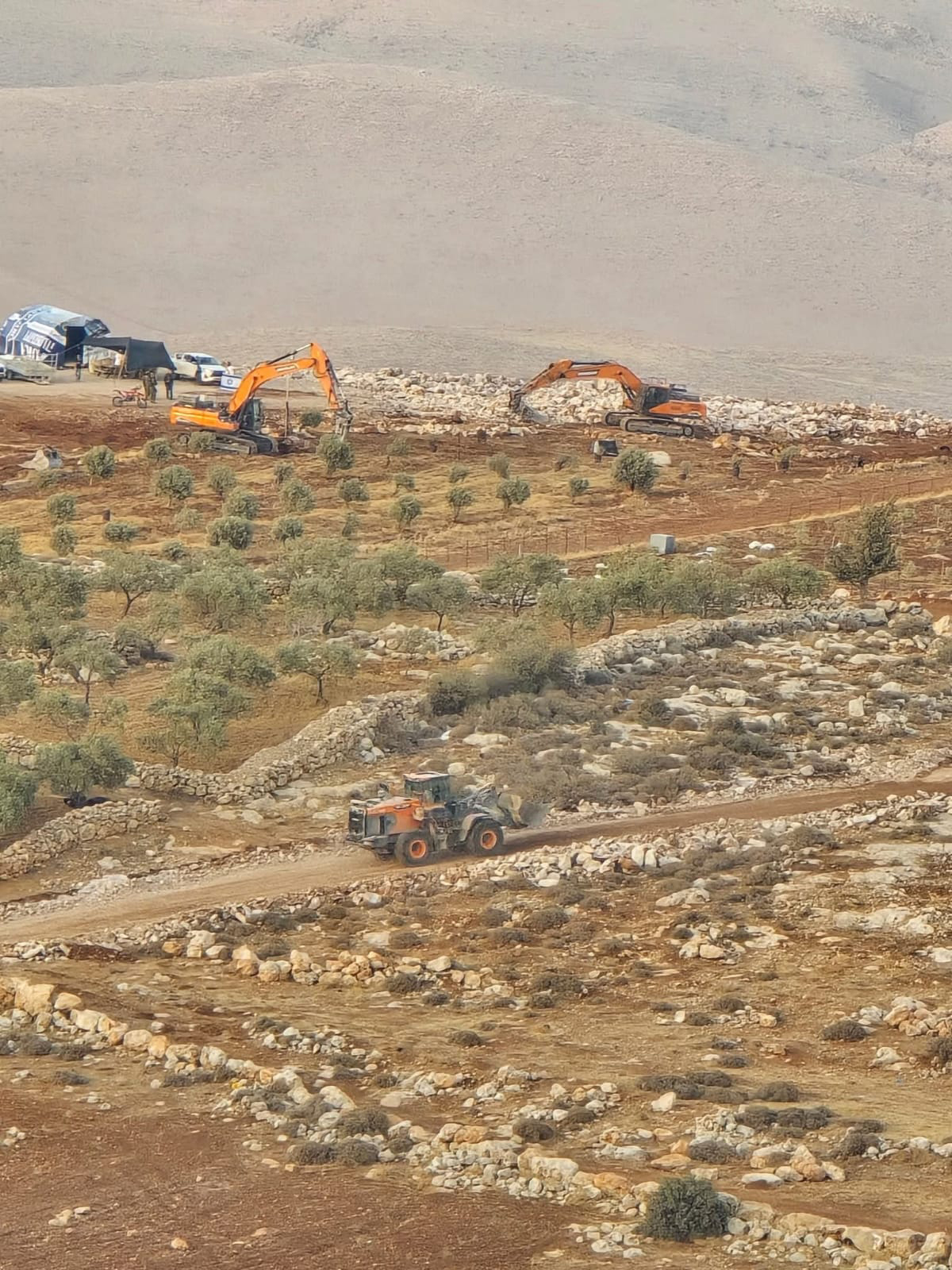
Earthworks for the establishment of the Giborey David outpost. Photo: Salma a-Deb'i, B'Tselem
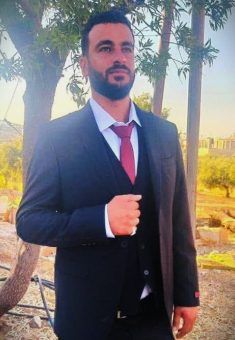
Thamin Dawabsheh. Photo courtesy of the family
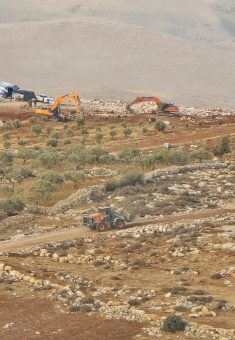
On Wednesday, 13 August 2025, at around 10:30 A.M., about 25 village residents gathered in the eastern part of Duma and started marching towards settlers who were carrying out earthworks on private land owned by residents. Several days prior, settlers began clearing a road to connect the outpost of Giborey David Farm, then under construction, to another outpost established nearby in early July.
The march was a protest against the settlers’ growing encroachment and against an assault by two settlers on a Palestinian teen in the area earlier that day. Among the protesters was 35-year-old Thamin Dawabsheh, a father of two from the village.
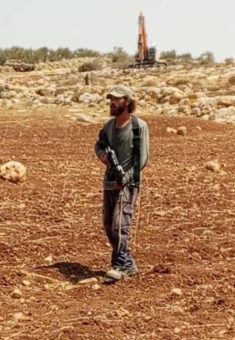
The residents came within several dozen meters of the bulldozer, which was working under the supervision of four Israelis in plain clothes. Three later turned out to be settlers, one of whom was carrying a handgun. The fourth was a soldier on leave hired as a private security guard, who was carrying a rifle.
The off-duty soldier and one of the settlers approached the residents. The settler filmed them with his cellphone, and the soldier fired several shots in the air and at the ground. Then, as seen in video footage of the incident, Thamin Dawabsheh threw a single stone toward the soldier, who immediately shot him and then fired at other residents.
Dawabsheh was hit by the gunfire and fell to the ground. The soldier kept shooting as several residents threw stones toward him, while others ran at him and tackled him to the ground to make him stop shooting. They pinned him down but were too afraid to touch his rifle, and he continued firing until his magazine was spent.
The settler who fired. Photo courtesy of local residents
At that point, the settler who had a handgun and had been standing by the bulldozer a few hundred meters away, also fired towards the residents but did not hit anyone. The residents let go of the soldier, and a few minutes later, three uniformed soldiers arrived, firing in the air, and the residents dispersed.
Thamin Dawabsheh was taken in a car to the village clinic, where resuscitation efforts failed. The bullet that struck his thigh caused massive bleeding. He was then transferred to Rafidya Hospital in Nablus, where doctors pronounced him dead.
Dawabsheh was buried in Duma the next day, and that same night, Israeli forces raided the village and arrested five residents on suspicion of incitement. Two were later released after posting bail of several thousand shekels, while the others remain in custody.
After Dawabsheh’s killing, the IDF Spokesperson released a statement claiming that the deadly shooting occurred “during civilian engineering work” near the village, when “dozens of Palestinian assailants threw stones at an off-duty IDF soldier” and attempted to seize his weapon.
B’Tselem’s investigation paints a different picture. Contrary to the euphemistic language used in the official statement, this was not “engineering work” but a seizure of privately-owned Palestinian land for the purpose of expanding settler outposts, and the soldier in question was providing security in a private capacity as a side hustle. Palestinian landowners and unarmed locals staged a peaceful protest against the land grab. The video footage shows that before the shooting, a single stone was thrown, by Thamin Dawabsheh, hitting no one. The investigation further revealed that the Palestinians did not try to seize the soldier’s firearm, which remained in his hands. They merely tried to restrain him as he kept firing indiscriminately.
B’Tselem field researcher Salma a-Deb’i collected testimonies from residents who were present at the scene; two of them appear below.
‘A.D., a father of three, recounted:
A settlers' bulldozer clearing a road on village land. Photo courtesy of local residents
On Wednesday, 13 August 2025, at around 10:30 A.M., I was visiting my father’s house on the eastern side of the village, in an area called Khallet al-Hasad. I heard a commotion outside and went out to see what was happening. I found out that earlier, settlers had tried to kidnap a neighborhood boy as he was riding his bicycle near the houses, and residents managed to rescue him. People who were outraged by what happened gathered in the neighborhood. We don’t feel safe any more even near our homes, and we fear for our children.
For several weeks now, settlers have been building a gravel road leading to an outpost they built on a hill called a-Ras, west of the village. Every day, they come to a site that overlooks Khallet al-Hasad neighborhood. We’re worried the road they’re trying to build will cut the village off from its lands, and maybe also connect the outpost to nearby ones in the Jordan Valley, in order to dispossess us of our land and our rights.
About 20 to 25 villagers gathered, and we decided to go to the site where the settlers were working with bulldozers to protest the attack. We went there on a spontaneous, nonviolent protest action to demand that the settlers keep away from us and from our children.
The bulldozer kept working, and four settlers stood nearby. Two of them walked over to us. One, who later turned out to be a soldier, wore a hat, had a beard and long sidelocks, and carried a large gun. The other, younger, about 18 years old, also with long sidelocks and glasses, filmed us with his cellphone.
The armed settler [the soldier] fired two shots in the air from about 50 meters away, apparently to scare us and make us back away, but we kept walking toward them. We didn’t want trouble, only to make sure our children are safe. We moved forward to tell them to stay away from us.
The same settler fired again, this time at the ground, raising up a cloud of dust. Every few meters as he came closer, he fired several shots. When we got nearer, one of us asked him in Hebrew, “Why are you shooting? We just want to talk. We don’t want any trouble. Why did you kidnap the boy?” But he only replied in Arabic, “Ruh min hon” (“Go away”). It was clear he wasn’t willing to listen or talk.
I tried speaking to him in English, but that didn’t help either. Then, when I was already near him, he suddenly started shooting wildly. I realized someone had thrown a stone at him, but it didn’t hit. At that moment, I saw my cousin Thamin fall to the ground. He was badly wounded in the thigh and bleeding heavily. I tried talking to him, but he lost consciousness.
Some of the young men grabbed the settler and knocked him down, but he kept shooting. No one dared touch his gun, which he was still holding with his finger on the trigger and firing, until the bullets ran out.
Meanwhile, two male soldiers and a female soldier came from the direction of the new road the settlers had built. They fired in the air as they came toward us. The young men let go of the settler once his bullets were spent. The other settler, the younger one, ran toward the bulldozer, and then one of the settlers who was standing near the bulldozer aimed a handgun at us and fired several shots, but didn’t hit anyone.
I didn’t know what to do about Thamin, who was bleeding. We had no way to give him first aid. We carried him, put him in a car, and took him to the village clinic, where, after resuscitation efforts, the doctor told us there was no pulse.
He was taken by ambulance to Nablus, and I went with him. The whole way, I kept looking at him and couldn’t believe it. I just hoped he would wake up, that a miracle would happen, that the doctors at the hospital would be able to save him. But it was in vain.
In the emergency room, the doctor confirmed there had been massive bleeding. His heart couldn’t handle the amount of blood he’d lost, and he was pronounced dead.
Thamin was married with two children, and his wife is four months pregnant.
H.D., 15, a resident of the village, recounted:
The armed settler [the soldier] fired two shots in the air, but people kept advancing, and then he fired several rounds at the ground. He advanced a few meters at a time, then fired a few shots. I saw him switch magazines.
When we were close enough to speak, people called out to him: “Don’t shoot! We just want to know what you wanted from the boy, why you attacked him!” But the settler only replied in Arabic, “Ruhu min hon” (“Go away”). One of us spoke to him in English, others in Hebrew and Arabic, but he kept repeating only: “Ruhu min hon.”
Then, he suddenly fired at us with his large gun. I saw Thamin fall to the ground. He was right next to me, only about a meter away. I saw his leg twisted at a strange angle, and he collapsed, tensed up, and then his body went limp and he closed his eyes. I realized the injury was severe. He was bleeding heavily from his thigh.
I froze in place until one of the residents pulled me by the hand to run. I ran a few steps and then turned back to see what was happening.
The young men overpowered the settler to stop him from shooting anyone else, but he was still holding the trigger and firing. The other settler, who had been standing next to him, ran toward the bulldozer. I noticed that the settler inside the bulldozer fired a handgun but didn’t hit anyone.
Two male soldiers and a female soldier arrived and fired into the air. The residents carried Thamin and put him in one of the cars that had arrived at the scene. I went home with my uncle and found out there that Thamin had died.
Israel’s regime of apartheid and occupation is inextricably bound up in human rights violations. B’Tselem strives to end this regime, as that is the only way forward to a future in which human rights, democracy, liberty and equality are ensured to all people, both Palestinian and Israeli, living between the Jordan River and the Mediterranean Sea.
Since the Hamas attack on 7 October 2023, Israel has acted in a coordinated and deliberate manner to destroy Palestinian society in the Gaza Strip, committing genocide against its residents. In light of Israel’s actions in Gaza, the public statements made by Israeli decision-makers, and the international community’s failure to take effective action, there is a serious risk that the Israeli regime will expand the genocide to other areas under its control—first and foremost, the West Bank.
B’Tselem calls on the Israeli public and the international community to use every tool available under international law to bring an immediate end to Israel’s genocide against the Palestinian people.